


Propps: Digital Business Card
Propps
I first looked at Propps: Digital Business Card as something a household or small team might use together, rather than as just another contact tool. That distinction matters. A digital business card is useful when several people need to present themselves consistently, but it can become confusing if everyone treats one shared profile as if it belonged to them personally. Propps, developed by Propps, is aimed at the business side of that problem: helping people connect, share their professional identity, and keep introductions more convenient than passing around printed cards.
My overall impression is positive, with an important qualification. This is a focused business app, not a complete customer relationship system or a replacement for a full contact manager. Its appeal is in making a professional introduction easier to repeat and easier to share. The app is free to install, carries an Everyone age rating, and has reached more than ten thousand installs. That makes it approachable for trying out, although the presence of optional purchases means I would still pay attention before confirming anything inside the app.
How Propps Works When Several People Share a Device
A realistic example is a family-owned service business where one phone sits at the front desk. One person may handle incoming enquiries in the morning, another may attend appointments later, and a third may use the device at an event. In that situation, a digital card can help each person introduce the business quickly. The practical challenge is not simply sharing a card; it is making sure the right person is represented at the right moment.
I would avoid treating a shared phone as a shared identity. If the app is opened with one person’s details already visible, another household member could accidentally share the wrong contact information. That is less a criticism of Propps than a reminder that business identity and device ownership are different things. Before using it in a shared setting, I would agree on who is responsible for the profile, what information belongs on it, and when another user should stop and check before sharing.
For a small household business, the strongest use case is a clear division of roles. The owner might maintain the main business identity, while each person uses the app only when introducing that business in their own role. A shared device can support this arrangement, but it should not replace a simple spoken rule such as “check the name and contact details before sending.” That small habit prevents the most likely mistake: forwarding a perfectly polished card that belongs to somebody else.
Related News

Why WhatsApp Messenger Still Makes Everyday Communication Feel Easy

Jurassic World: The Game Is the Better Dino Tycoon for Strategic Players

Threads in Real Life: Who Should Join, Lurk, or Leave

How SHEIN Turned Shopping Into an Endless Content Feed

How to Make Fortnite Feel Smarter on Mobile

Should You Switch to Microsoft Outlook on Mobile?
I also see value for people who attend local events together. Instead of carrying a stack of paper cards, the group can decide which profile should be shared in a particular conversation. The benefit is consistency, especially when the business name and contact route need to remain the same. The trade-off is that a digital card still depends on the recipient being comfortable receiving or opening digital contact information. Paper remains more universal in some face-to-face situations.
Separate ownership before the first share
The setup stage deserves more care than the short store summary suggests. I would begin by deciding whether the profile represents an individual, a household business, or a shared brand. Those are three different identities. An individual card should use one person’s name and role. A business card should make the company or service the main point. A household profile may need extra clarity so that recipients know whom they are actually contacting.
This is one of the most useful decisions to make before adding details: choose the smallest identity that can answer the recipient’s likely question. If people usually need to know who will call them back, include the responsible person’s role. If they only need the business name and general contact route, do not overload the profile with personal information. A concise card is easier to trust and less likely to expose details that do not belong in a first introduction.
Gallery
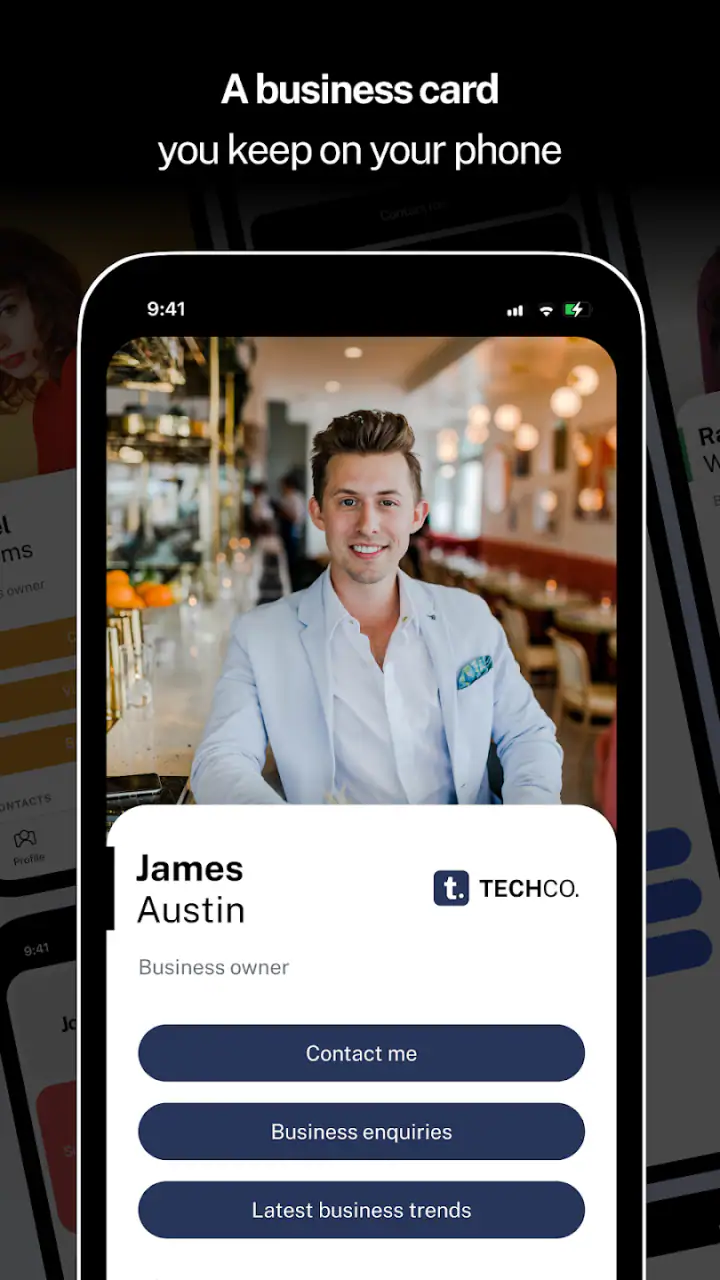
I would also create a quick checking routine for shared use. Read the displayed name, role, and contact method aloud before sharing it at an event or from a reception desk. That may sound excessive, but it is faster than correcting an awkward introduction later. The routine is particularly useful when several people use one phone and the app remains open between conversations.
Account boundaries are equally important. Each person should know whether they are editing a profile or merely sharing one. Editing changes the identity that future recipients may see, while sharing only sends the current identity onward. Confusing those actions can create a quiet but serious problem: one person updates a shared card for their own needs and unintentionally changes how the next person presents the business.
Because Propps is a business app rather than a household-management tool, I would not expect it to solve those boundaries automatically. The safest approach is to keep responsibility explicit. One trusted person should review the information periodically, while everyone else should treat the profile as something to use carefully rather than casually modify.
Coordination is where the app earns its place
The useful part of a digital business card is not the novelty of replacing paper. It is the coordination around a first contact. In my view, Propps makes the most sense when a household or small team needs a repeatable introduction and wants everyone to point people toward the same professional presence.
For example, imagine two relatives running a repair service. One meets a potential customer at a community event, while another answers messages later. A consistent card can reduce the chance that the customer receives an outdated number from one person and a different route from another. The app does not remove the need for follow-up, but it can make the handoff cleaner: the first person introduces the service, and the second person knows where the enquiry originated.
A useful workflow is to agree on one primary contact route and keep personal alternatives secondary. If every household member shares a different destination, the customer has to decide whom to trust and whom to contact. A single, clearly maintained route is usually better for the business. Personal details can still matter, but they should support the shared identity rather than compete with it.
I would also use the card as an introduction, not as a complete sales pitch. Sending too much information at the first contact can feel impersonal. A short professional identity gives the recipient a reason to continue the conversation; the actual service details can follow in a normal message or conversation. This is a subtle advantage of restraint: the card stays useful in many contexts instead of becoming a crowded advertisement.
There is another trade-off for shared devices. Convenience encourages people to share quickly, but speed can hide errors. If the device is passed around at a market stall, a visitor may assume the displayed profile belongs to the person holding the phone. I would make the speaker identify themselves verbally before sharing. That one sentence creates a boundary that the screen alone may not provide.
Compared with paper cards, Propps is more adaptable because a digital identity can be easier to distribute repeatedly without carrying a physical supply. Compared with a normal contact app, it is more presentation-focused: the goal is not merely to store someone’s number, but to introduce a professional identity. Compared with a full business networking platform, it is likely to feel narrower and simpler, which is an advantage for quick introductions but a limitation for users who need detailed lead tracking, team permissions, or customer histories.
Trust, age, and the person holding the phone
The Everyone age rating makes the app broadly approachable from an age-classification perspective, but that should not be confused with every business use being suitable for every child. A young person might help at a family stall or pass along a business identity, yet an adult should decide which information is appropriate to share and who is responsible for responding to enquiries.
I would be especially careful when a shared household device contains both adult business details and personal information. A child using the phone for another reason could encounter the profile, or an adult could accidentally share a personal route when the business route was intended. The solution is not to assume the app understands the family structure; it is to keep the profile deliberately limited and teach younger users when not to share it.
Trust also applies to recipients. A digital card can make an introduction feel official, but the recipient still needs to recognize the person and the business behind it. I would not use the app as a reason to send sensitive information to someone met only moments earlier. The card should contain enough to continue a legitimate conversation, not enough to expose unnecessary personal details.
For older relatives who are less comfortable with apps, the main benefit may be that another household member can handle the sharing while they focus on speaking with the customer. That arrangement works best when the older person knows exactly what is being sent. I would show them the profile, explain the contact route, and agree on a simple phrase they can use when they want the card shared. Familiarity builds more trust than silently handing over a phone.
Privacy is therefore a matter of content and coordination, not just age rating. I would leave out information that is not needed for a first business contact, review the profile after a change in phone numbers or roles, and avoid using one person’s private details as the default identity for the entire household. These habits make the app safer and more professional without requiring complicated procedures.
Practical limits and the cost question
Propps is free to download, which lowers the barrier for a small business or an individual testing the idea. Its current version is 2.6.2, and it supports devices running Android 7.0 or later. That Android requirement is fairly accessible for many users, though anyone relying on an older phone should check compatibility before building a workflow around it.
The free entry point is helpful, but optional in-app purchases range from $1.99 to $134.99 per item. I would not assume that every useful capability is included without cost. Before inviting several household members to depend on the app, I would inspect the purchase screens carefully and decide whether the free experience is enough for the intended use. A casual individual may be satisfied, while a growing team should compare the total cost with other business-card and contact-management options.
The app has an average rating of 4.2 from around twenty-nine ratings, with four written reviews. That is encouraging, but it is still a relatively small public sample. I would treat the rating as a helpful signal rather than proof that every workflow will suit a shared household. My own decision would depend more on whether the app’s identity-sharing approach matches the way the group actually works.
The main limitation is scope. A digital card can start a relationship, but it does not automatically organize the relationship afterward. If you need a pipeline of leads, appointment scheduling, shared notes, detailed permissions, or a full history of customer communication, a CRM or team workspace will be a better fit. Propps may complement those tools, but I would not select it as their substitute.
Another limitation is human error. A card can be accurate when created and still become misleading when roles change. Shared households often have informal responsibilities, and that informality can make outdated information linger. I would assign one person to review the profile whenever the business changes its contact route, services, or staffing. That maintenance step is more important than adding extra decoration to the card.
Who should use it, and who should choose something else?
I would recommend Propps to an independent professional who wants a simple way to present a business identity, a family-run service that needs a consistent introduction, or a small group that regularly meets potential customers in person. It is also a sensible option for someone who dislikes carrying printed cards and prefers a digital-first introduction.
I would be more cautious for a household with many people sharing one device but no agreed ownership of the profile. The app can support coordination, but it cannot replace clear responsibility. If several people need separate identities, separate accounts or another system designed around team roles may be more appropriate than trying to make one card serve everyone.
I would also look elsewhere if the main goal is customer management rather than introduction. A conventional contact manager is better for organizing numbers and notes. A CRM is better for tracking enquiries and follow-ups. Printed cards remain useful when recipients have limited digital access or when the setting makes phone-based sharing awkward. Propps is strongest in the space between those choices: a professional identity that can be shared quickly and consistently.
One non-obvious advantage is that the app encourages a household to clarify its public identity. Before using it well, you have to decide whether you are presenting a person, a service, or a business. That decision alone can improve conversations. One non-obvious weakness is the reverse: if the household has not made that decision, the app can make the confusion look more polished without actually solving it.
My household verdict
After considering the shared-device scenario, I see Propps as a useful specialist tool rather than an all-purpose business platform. I like it for the moment when someone asks, “How can I contact you?” and the answer needs to be professional, consistent, and easy to pass along. The app’s free starting point makes experimentation reasonable, while the Everyone rating and broad Android compatibility make it accessible for many households.
I would use it with clear boundaries: one person maintains the identity, each user checks the profile before sharing, and the card contains only information needed for a first business connection. Those three rules address most of the practical friction I would expect in a shared setting. They also keep the app from becoming a source of accidental oversharing or mixed identities.
My recommendation is therefore positive for individuals and small household businesses that need a digital introduction, but conditional for larger or more structured teams. Propps can help people connect, share a professional presence, and begin a conversation. It is not the right choice when the real need is customer records, complex team access, or detailed follow-up management. Used for its actual strength, it is a convenient business card with a useful role in everyday coordination.
My final advice is simple: decide whose identity the card represents before you decide how often to share it. That small step turns Propps from a shared phone shortcut into a more reliable part of a household business routine.
FAQs for Propps: Digital Business Card
What is Propps: Digital Business Card, and how does it work?
Propps: Digital Business Card is an app designed to help you create and share a professional digital contact profile instead of relying only on printed business cards. You can typically add details such as your name, job title, company, phone number, email address, website, social media links, and profile photo. Once your card is ready, you can share it digitally through a link, QR code, or compatible sharing options, making it easier for new contacts to save your information.
Can I customize my digital business card in Propps?
Yes, customization is one of the main reasons to use Propps. After creating a profile, you can usually adjust your personal and business information, add branding elements, and choose how your card appears to people who view it. Depending on the available plan and app version, some design tools or advanced branding features may be limited. It is worth reviewing the editing options before publishing your card to ensure it matches your professional image.
How do I share my Propps digital business card with someone?
Propps is intended to make exchanging contact details quicker than handing over a physical card. You can share your profile using its generated digital link or QR code, and you may also be able to send it through messaging, email, social platforms, or nearby-device sharing features supported by your phone. The recipient generally does not need to carry a printed card, although the exact sharing methods can vary between Android and iOS versions.
Does the person receiving my Propps card need to install the app?
In most cases, a recipient can open a shared digital business card through a web link without installing Propps, which makes the service more convenient during meetings, conferences, and networking events. However, certain features may work better or be available only inside the app. Recipients might also need to grant permission or follow an additional step if they want to save your information directly to their contacts.
Is Propps: Digital Business Card free to use?
Propps may offer a free way to create or share a basic digital business card, while additional tools can depend on subscriptions, premium packages, or account limits. Before downloading, check the current listing in the Google Play Store or Apple App Store for pricing, in-app purchases, trial conditions, and renewal details. Also review which features are included at no cost, particularly if you need multiple cards, advanced customization, analytics, or business-focused management options.
Pros
- Creates a professional digital identity without printing paper cards.
- Lets you share contact details instantly through a single profile link.
- Easy to update information without reprinting or redistributing cards.
- Useful for networking at events
- meetings
- and business appointments.
- Supports a modern
- eco-friendly alternative to traditional business cards.
Cons
- Some features may require a paid plan or in-app subscription.
- Recipients may need internet access to view the shared profile.
- Limited appeal for contacts who prefer physical business cards.
- Privacy depends on how publicly your contact details are shared.
- Profile customization may not match every brand’s visual identity.


